
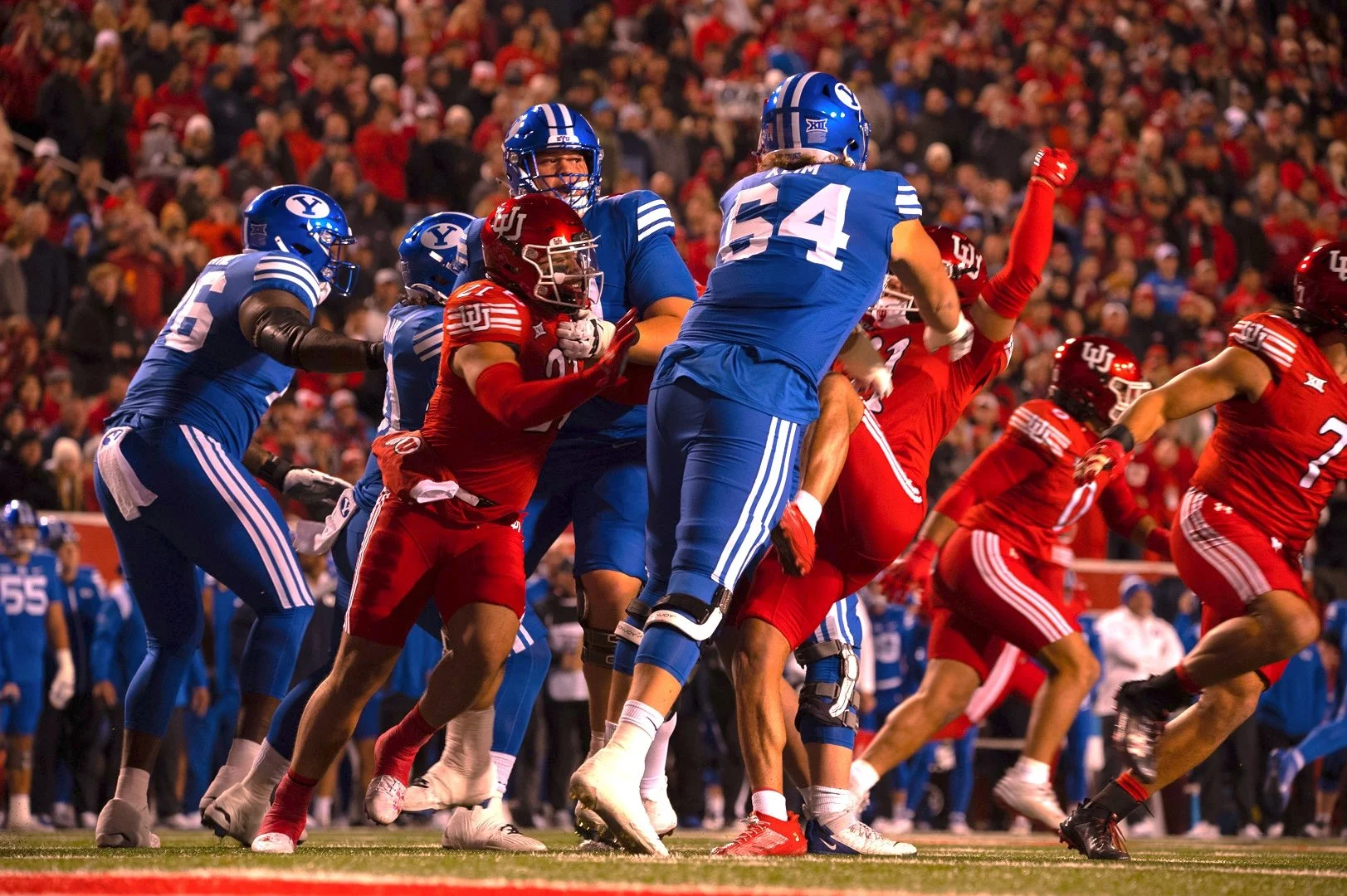
A 2026 Utah Political Trends panel survey of 786 Utahns conducted October 27-29 by Y² Analytics and Public Wisdom finds the state nearly split down the middle in their support of BYU and the University of Utah. When Utahns are asked which Utah school they usually cheer for, BYU edges out Utah 37% to 34% (with the remainder supporting other teams or no team from the state in particular). However, when everybody is asked to pick a side, Utah pulls ahead narrowly. Roughly 52% of Utahns end up in the Utes’ corner compared with 48% for the Cougars.
Not everything about the rivalry is split down the middle, though. More than 3 in 4 BYU fans (77%) say they would cheer for the Utes if Utah were playing an out of state team in a playoff or conference championship game. Fewer than half of Utah fans (47%) say the same about BYU.
“The rivalry is about as evenly split as it gets, but the two fan bases don’t treat each other the same way,” said Jade Burt, Ph.D., a director at Y² Analytics. “Most BYU fans are willing to root for Utah once the rivalry game is over. Most Utah fans are not willing to return the favor.” Burt continued, “Religion seems to be the main thing that divides supporters of the two teams. Although some Latter-day Saints cheer for Utah and some non-LDS Utahns cheer for BYU, religion is definitely the biggest driver of what team people cheer for.”
Who will Utahns be cheering for in the Holy War game?
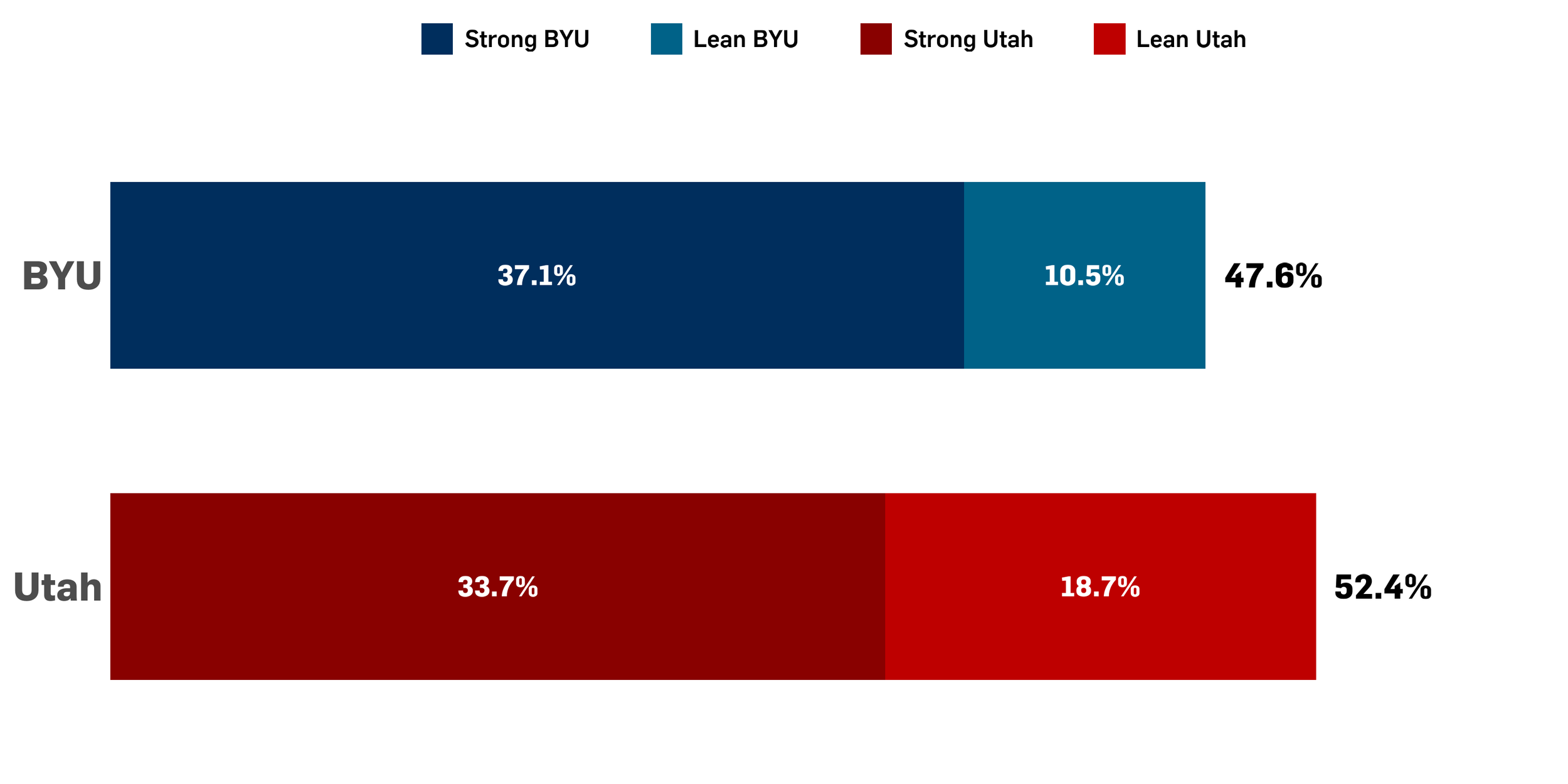
Overall Utah numbers, by strong and leaning fans, then both combined
Key Findings
· Utah’s populace is about evenly split between the two universities’ fan bases: 37% of Utahns cheer for BYU and 34% for Utah. Utahns who root for another Utah school or none at all lean toward Utah 64% to 36% for the rivalry game, putting Utah ahead 52-48 overall.
· Two-thirds of Utahns (68%) describe the rivalry as extremely or very intense, and 52% plan to watch the game on November 7th. 72% of BYU fans classify the rivalry as extremely or very intense, compared to 62% of Utah fans that say the same.
· Religion is a clear dividing line: 80% of active Latter-Day Saints side with BYU, while 93% of members of other faiths and 88% of nonreligious Utahns side with Utah. Less-active Latter-day Saints side with BYU for the most part, with 61% preferring BYU.
· BYU fans are far more willing to support Utah in a conference championship or playoff game. 77% of BYU fans would cheer for Utah against an out-of-state opponent, compared with 47% of Utah fans who would cheer for BYU. Utah fans are more than twice as likely to say they would definitely root against their rival (24% v. 10%).
defining leaners
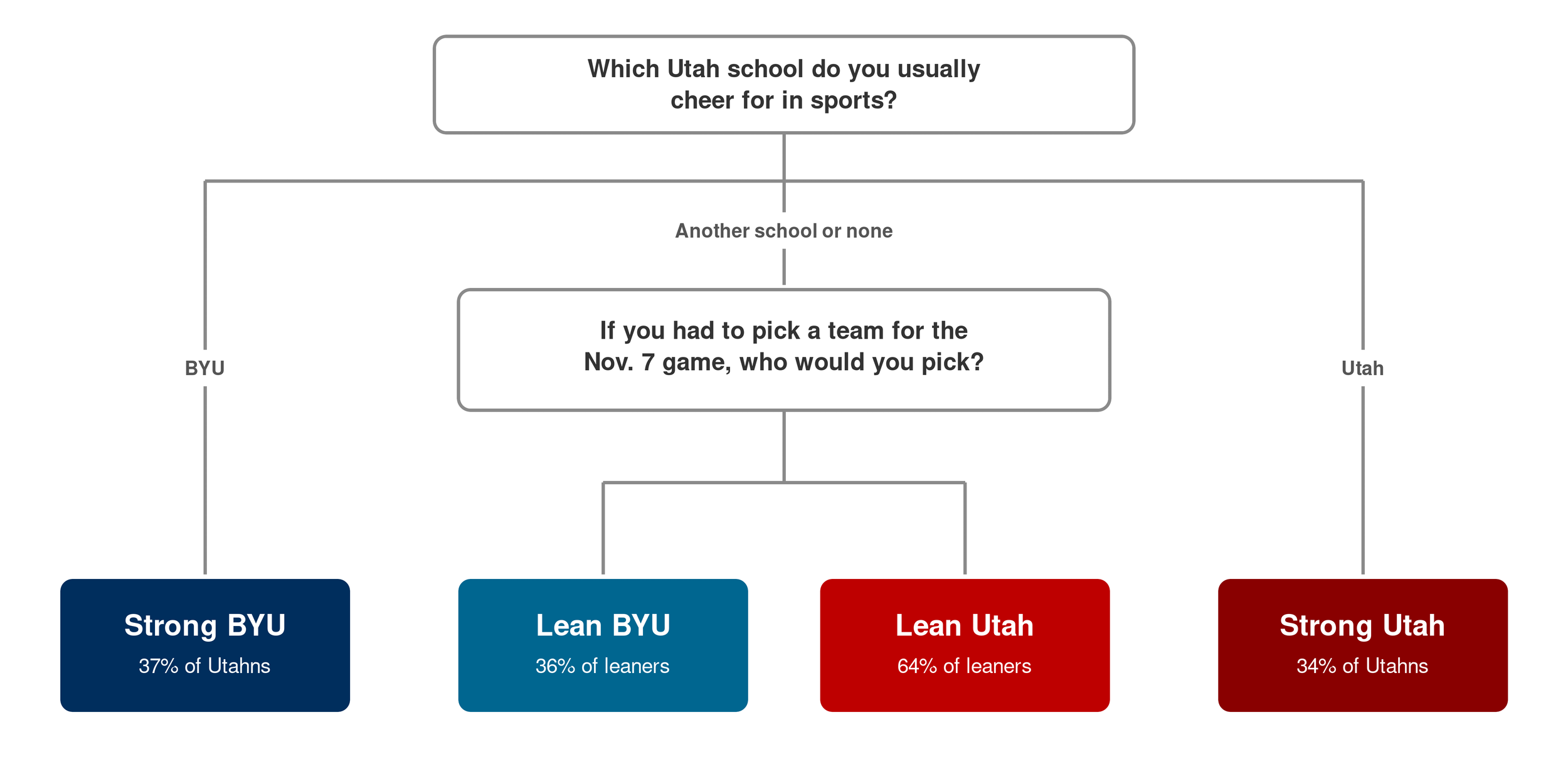
Throughout our analysis, we use the words “Strong” BYU/Utah fans and “Lean” BYU/Utah fans. Strong fans are those who, when asked which Utah school they follow when it comes to college sports, said either BYU or Utah. Those who said a different Utah D1 school, or said no Utah school at all, were asked a follow-up about who they would root for if they had to choose for the upcoming November 7th game. These fans are classified as “Leaners”.
RELIGION DRAWS THE BATTLE LINES
No single factor separates the two fan bases more than religion. Overall, nearly three-in-four (74%) self-identifying members of the Church of Jesus Christ of Latter-Day Saints side with BYU in the upcoming Holy War. When broken out by activity levels, eight in 10 active Latter-Day Saints (80%) side with BYU, including 65% who primarily cheer for BYU in general for college sports (Strong BYU fans). Less active Latter-Day Saints also favor BYU, though by a smaller margin (61% to 39%). On the other side, 93% of Utahns of other faiths and 88% of Utahns with no religious affiliation side with Utah, and a majority of each group cheer for Utah in general for college sports (Strong Utah fans).
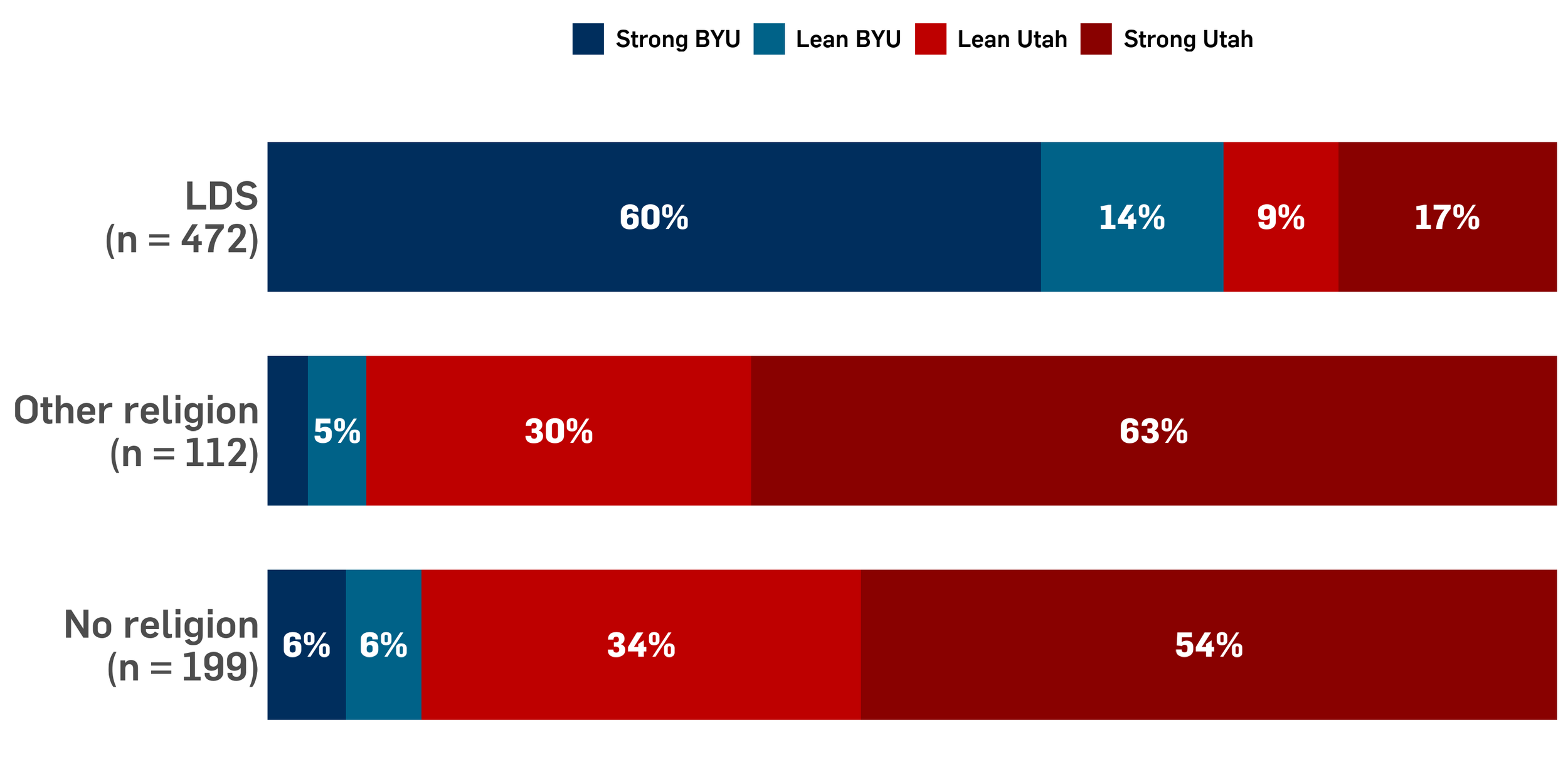
Strong and leaning team support by religion
AN INTENSE RIVALRY, BUT NOT AN EQUAL ONE
Two-thirds of Utahns (68%) say the BYU-Utah rivalry is extremely or very intense these days, and only 8% say it is not too or not at all intense. Active LDS Utahns are the most likely to call it extremely intense (35%), about twice the rate of Utahns with no religious affiliation (17%).
On a 0-to-100 feeling thermometer (100 being the most favorable and 0 being the least favorable), Utahns overall rate the University of Utah somewhat more warmly (an average of 68) than BYU (an average of 61). Ratings track closely with religion: Active Latter-day Saint Utahns give BYU an average of 82 and Utah 57, while members of other faiths give Utah 83 and BYU 40, and nonreligious Utahns give Utah 75 and BYU 35. In other words, Active LDS view Utah more warmly than other Utahns view BYU.
BYU FANS ARE MORE WILLING TO CROSS OVER
Respondents were asked whether they would cheer for their rival if it were playing a team from outside Utah in a playoff game or conference championship. More than three in four BYU fans (77%) would cheer for the Utes, including 49% who would definitely cheer for them. Utah fans are split: 47% would cheer for BYU, while 53% would not, including 24% who would definitely cheer against the Cougars. Only 10% of BYU fans say they would definitely cheer against Utah.
To understand what drives this, we asked respondents to tell us their feelings about each school on a scale from 0 to 100 where a rating of 0 means they feel very unfavorably towards the school and a rating of 100 means they feel very favorably towards the school. That allowed us to construct a measure of how polarized each fan is by taking the difference between their thermometer rating of their favored school and the rating of the rival school. A score of 0 means a fan feels the same about both schools; a score of 100 means they feel as warm possible toward their team and as cold as possible toward the rival.
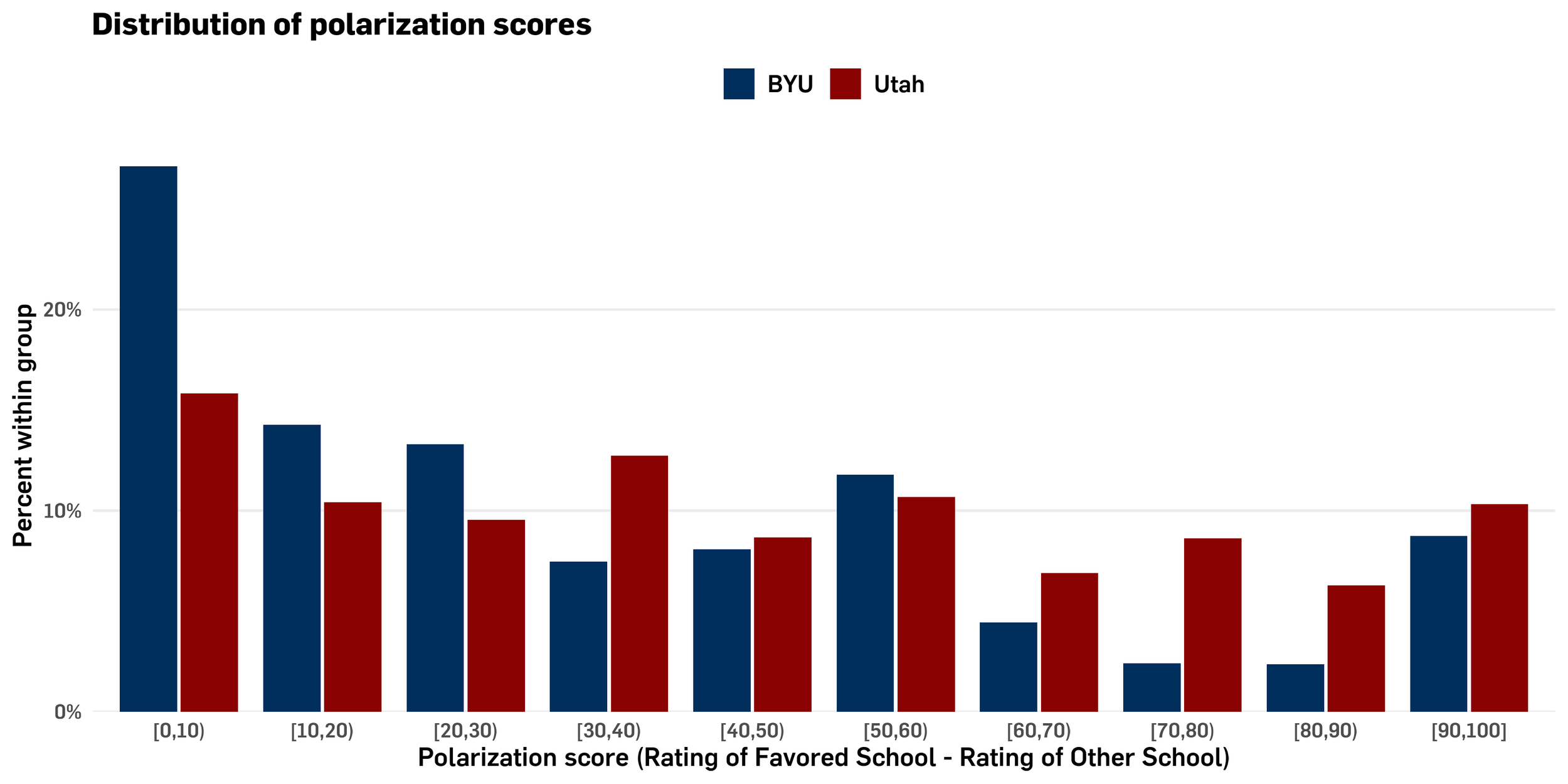
Distribution of polarization scores by BYU and Utah fans, with strong fans and leaners combined
When looking at the distributions of polarization scores by BYU and Utah fans, it’s clear that BYU fans are far less polarized. About 27% fall into the 0-10 bucket (meaning little to no polarization at all; they feel about as warmly towards BYU as they do towards Utah), which is significantly more than the 16% of Utah fans who fall into the same 0-10 bucket. On the other end, over 10% of Utah fans fall into the 90-100 bucket, meaning they feel as warm as possible towards the U and as cold as possible toward BYU, compared to about 9% of BYU’s fans who feel the opposite (warm towards BYU and cold towards the U). For the two schools, the size of this group of most highly polarized fans is not dramatically different.
The main difference between the fans of the two schools on this polarization metric is that fans of the U are significantly more likely to feel 60 to 90 points more warmly towards their school than BYU fans are towards theirs. 22% of Utah’s fan base falls into that highly polarized 60-90 range compared to just 8% of BYU’s.
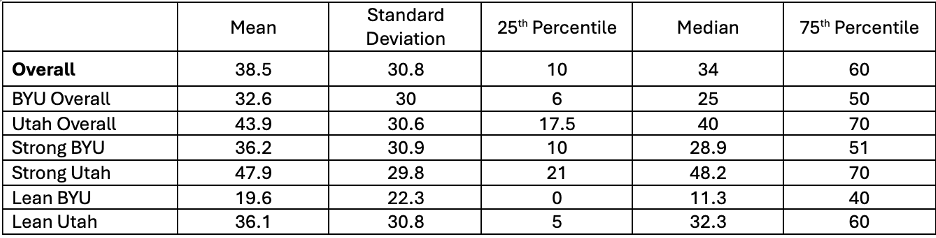
Summary statistics of polarization score (0-100 score of own school minus 0-100 score of rival school)
Overall, the average polarization score was 38.5, with a median of 34. However, across the board, Utah fans appear to be more polarized. Overall, Utah had an average of 43.9 (with 100 being the most polarized a person could be and 0 being the least), while BYU had a mean of 32.6. Utah overall had a median polarization score 15 points higher than BYU’s (40 compared to 25). Even when broken out by strong or leaning fans, Utah’s mean score was higher than BYU’s. Strong Utah fans had an average polarization score nearly 12 points higher than strong BYU fans (47.9 compared to 36.2), while the gap was even larger among leaners. Those categorized as leaning Utah fans had an average polarization score more than 16 points higher than leaning BYU fans (36.1 compared to 19.6).
Not surprisingly, the more polarized a fan is, the less likely they are to cheer for the other team. However, polarization alone doesn’t fully explain the differences in how willing each fan base is to cheer for the other. Even at the same level of polarization, BYU’s fans are more likely than Utah’s fans to cheer for their rival. We built a logistic regression model using our polarization score as a predictor of how likely fans of each team would be to cheer for the other in a conference championship or playoff game against an out-of-state team. Among the least-polarized fans of each school (strong and leaners combined), about 92% of BYU fans would cheer for Utah, compared with 73% of Utah fans who would cheer for BYU. Among fans of each school who score 50 on the polarization scale (those who feel 50 points more warmly towards their own school than their rival), we would expect 70% of BYU fans to cheer for their rival, but only 42% of Utah fans willing to do the same.
In fact, at every level of polarization, a fan of BYU is more likely to cheer for Utah against an out-of-state opponent in a big game than a Ute fan is to cheer for BYU in a similar situation. In short, the difference between the fan bases isn’t only about how strongly they feel about the two schools: Utah fans are less willing to root for BYU than BYU fans are to root for Utah even when we hold how they feel about their rival constant.
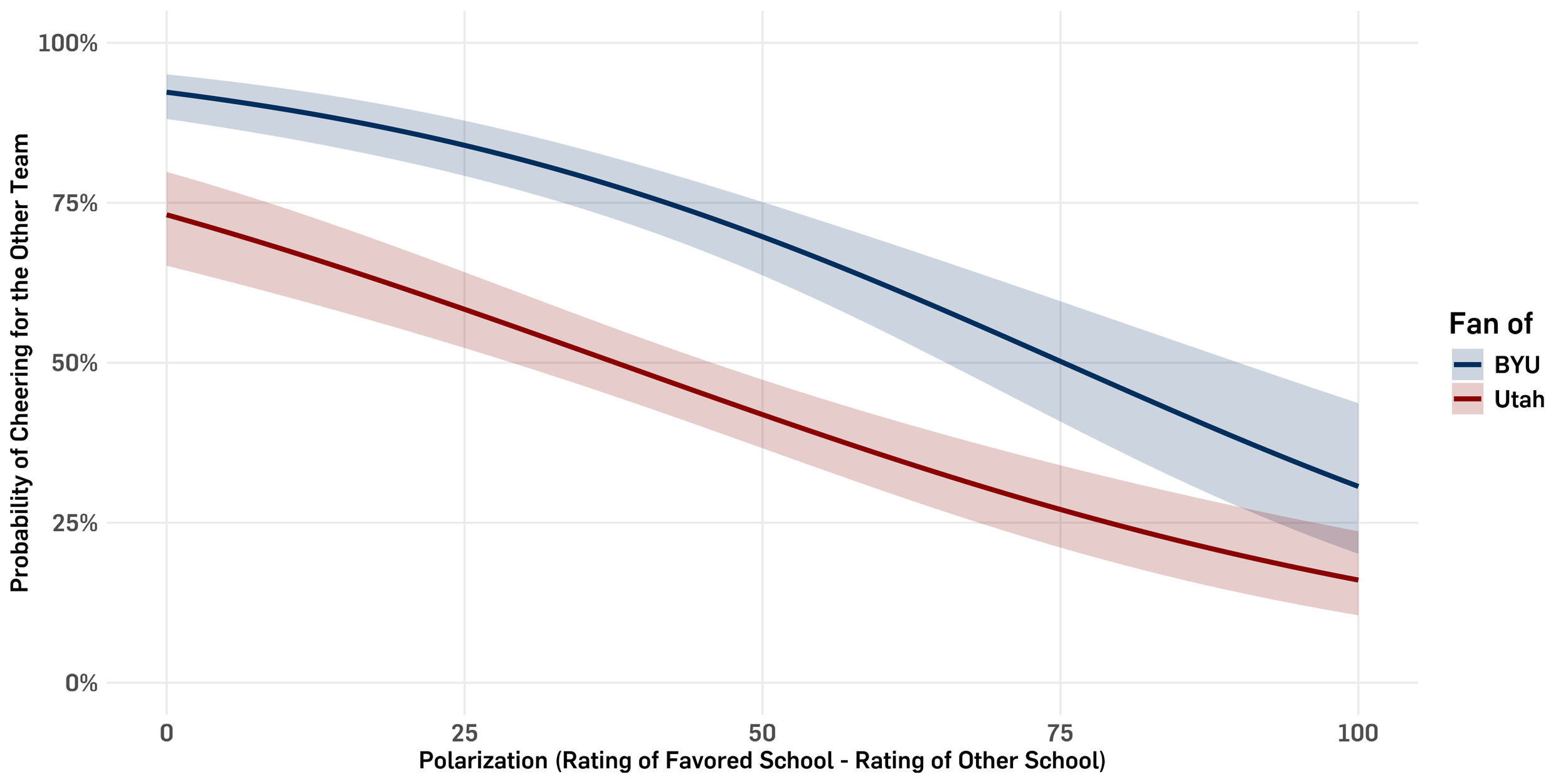
Predicted probability of cheering for the other team by polarization, including leaners
This presents a minor paradox—BYU fans, even when holding polarization constant, are more willing to cheer for their rivals when they aren’t playing each other but BYU fans also view the rivalry as more intense than Utah fans! When asked how intense the BYU-Utah rivalry is these days, 72%of BYU fans called it “Extremely” or “Very intense” compared to only 62% of Utah fans who said the same. This shows that hostility towards a rival is not necessary to sustain feelings of intensity in a college football rivalry.
Beyond influencing which team Utahns cheer for, religion also seems to have an impact on their willingness to cheer for the other team. 39% of active Latter-day Saints who initially supported the Utes said they’d “definitely cheer for” BYU in a playoff game or conference championship against a team from outside of the state. That’s significantly more than the 18% of non-religious Ute fans willing to do the same for BYU. Similarly, a stunning 91% of those of a non-LDS faith who said they’d support BYU against Utah said they’d definitely cheer for the Utes in a major game against a team from out-of-state. That’s greater than the share of active (48%) or less-active (50%) members of the Church of Jesus Christ of Latter-Day Saints who say the same. So, while religion plays a role in determining who you cheer for, those we might call “defectors” are still likely to have a soft spot for the team their religion (or lack thereof) suggests they might support.
LEANERS PREFER THE UNIVERSITY OF UTAH
Asked which Utah school they usually cheer for in college sports, 37% of Utahns choose BYU and 34% choose Utah. Another 7% usually cheer for Utah State; with 1% each for Utah Valley, Southern Utah, Utah Tech, and Weber State; and 18% don’t usually cheer for any Utah school.
When those Utahns who didn’t initially pick BYU or Utah were asked to pick a side for the rivalry game, nearly two-thirds (64%) chose Utah. A majority of fans of every other Utah school broke toward the Utes on their second-preference choices, ranging from 57% of Utah State fans to 77% of Weber State fans, as did Utahns who don’t usually follow a Utah school (65%). Many of these groups are small so their individual estimates should be read with caution, but the direction is consistent across all of them.
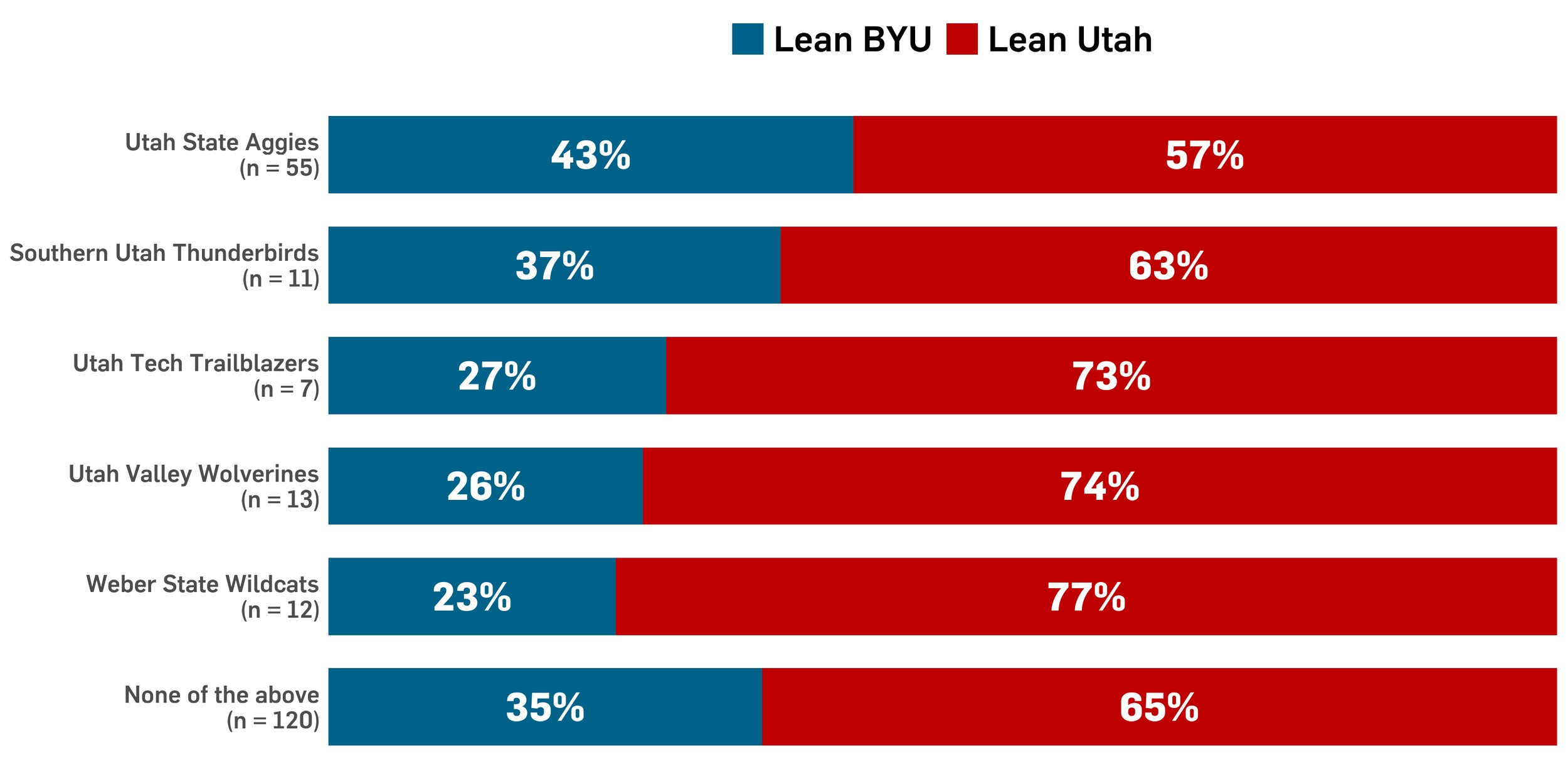
Which team fans of other Utah schools (and none) would choose in the BYU-Utah game
CONCLUSION
Ten years ago, ESPN proclaimed that “we might be in for a softer, gentler Holy War.” It was Kalani Sitake’s first season as BYU’s head coach. He and Kyle Whittingham, Utah’s then-head coach, were “exchanging pleasantries [rather than] jabs through the media.” That chapter of the Holy War has now closed with Kyle Whittingham having moved on from Utah to his new head coaching job at Michigan. But as one chapter closes, a new one begins. On November 7th, the new Sitake-Scalley era of the Holy War begins.
It seems that Sitake-led BYU’s fan base has successfully maintained a feeling of intensity to the rivalry without stoking negative feelings towards the U and its fans. In this new era, we’ll get to see how the rivalry changes going forward.
If you would like to get email or text alerts going forward when we have a new blog post, please fill out our contact form at the link below.
ABOUT THIS SURVEY
Y² Analytics and Public Wisdom surveyed 786 Utah adults online from October 27th to 29th, 2026. Respondents were drawn from a previously recruited opinion panel. Initial recruitment to the panel from the voter file was done using probability proportionate to size (PPS) sampling based on the voter’s modeled likelihood of turnout out to vote in the 2026 general election. Survey invitations were sent via email and text message. Survey panelists were initially recruited by mail through the post service or through a text message invitation and their contact information was provided when they agreed to join the panel after this initial contact. Panel members had to affirm when they were recruited that they are registered to vote in Utah.
The data have been weighted to reflect the demographics of likely 2026 general election voters living in Utah. The data were weighted by county of residence, congressional district, sex, age, party registration, recalled 2024 presidential vote, race, education level, and modeled turnout quintile.
The margin of error for the full sample is ±3.5 percentage points, or approximately ±5 points after accounting for the effect of weighting; margins of error are larger for subgroups. Active and less active LDS were identified by a two-step process during the initial recruitment survey. Respondents were initially asked their religious preference. Those that indicated some religious preference were then asked how active they consider themselves in the practice of their religious preference. Those who described themselves as “very active” are categorized as active LDS.
Differences described as significant are statistically significant at p < 0.05 after correction for multiple comparisons. The full topline (pdf) and crosstabs (.xlsx) are available for download.
ABOUT Y² ANALYTICS
Y² Analytics is a survey research and analytics firm based in Salt Lake City with extensive experience measuring and analyzing public opinion, predicting consumer behavior, and providing data-driven strategy consulting. For more information about the survey or to inquire about asking questions to our panelists on a future survey, contact Jade Burt, Ph.D, at jade@y2analytics.com or (435) 799-1456. You can also contact Quin Monson, Ph.D, at quin@y2analytics.com or (801) 367-6588. For more information about Y² Analytics see https://y2analytics.com/.
Disclosure of team loyalties: Jade Burt is a graduate of Utah State University (B.S. Statistics, 2017; B.S. Political Science, 2017) and of the University of Michigan (Ph.D. Political Science, 2023).
Quin Monson is a professor of political science at Brigham Young University. He has degrees from BYU (B.A./M.A., 1996) and Ohio State University (M.A., 1999; Ph.D., 2004)
ABOUT PUBLIC WISDOM
Public Wisdom is a survey research firm based in Denver that specializes in recruiting and fielding scientifically accurate survey panels through random probability sampling. For more information see https://publicwisdom.io/.