
Nearly nine in ten Utahns (89%) agree that a person’s commitment to God requires treating other people fairly, and 93% say someone with different social and political priorities can still be a moral person, according to a new Utah Political Trends panel survey of 547 Utahns conducted September 17 to 21, 2026 by Y2 Analytics and Public Wisdom.
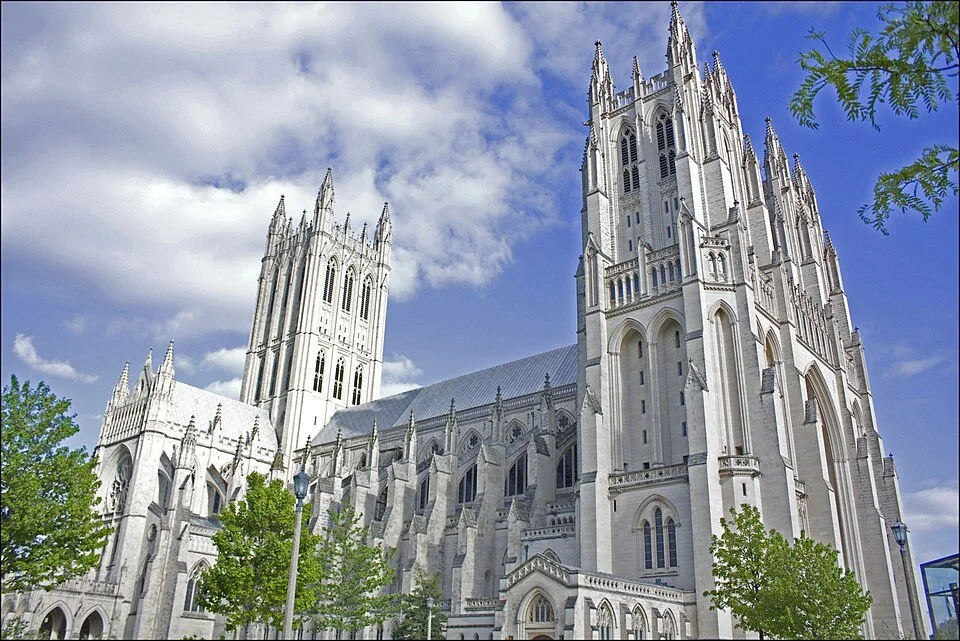
The survey tested ideas from “Faith, Freedom, and the Common Good,” the address President Dallin H. Oaks of The Church of Jesus Christ of Latter-day Saints gave at the Washington National Cathedral on September 16, the eve of Constitution Day. President Oaks argued that the Constitution requires people of differing viewpoints to find common ground without abandoning their core values. “The Constitution compels a divided people to build coalitions to allow them to act together,” he said. Those ideas drew broad support from Utahns of every religious and political background.
“Utahns disagree about plenty, but these results show wide agreement with the idea that people who differ should treat one another fairly and work together at finding solutions that include political compromise,” said Quin Monson, a partner of Y2 Analytics.
Key findings
· Majorities of Utahns agree with all six ideas from the speech that were tested, with agreement ranging from 66% to 93%.
· Agreement crosses religious lines: majorities of active Latter-day Saints, less active Latter-day Saints, members of other faiths, and nonreligious Utahns agree with at least five of the six statements.
· 44% of Utahns heard about the speech, and 86% of those viewed it favorably, including majorities of every religious and political group.
CIVIC THEOLOGY AND PLURALISM
Y2 Analytics wrote four statements that reflect ideas from President Oaks’ speech and asked Utahns how much they agree or disagree with each:
| Survey statement | Quote from President Oaks' Speech |
| "A person's commitment to God requires them to treat other people fairly." | "We need to work for a better way forward—a way to resolve differences without compromising core values. We should seek fairness for all." |
| "Finding compromises between competing political interests and religious values leads to better outcomes for everyone." | "This win-win outcome [The Utah Compromise] could not have been obtained without the balancing of interests made possible by the dynamics of a legislative process." |
| "Compromise usually weakens the integrity of religious beliefs."
(disagreeing with this statement aligns with President Oaks' message) |
We have learned to forge those compromises on policy necessary to achieve the freedom and unity to live at peace with those with whom we disagree on religious faith. At the same time, we have preserved the freedom required for us to continue our most important doctrines and practices." |
| "A person may have different social and political priorities than me and still be considered moral." | "We need to remind ourselves that our fellow citizens with whom we disagree — even deeply disagree about fundamental matters of justice and the common good — are not our enemies."
(President Oaks, quoting Robert P. George) |
Y2 Analytics also tested agreement with two statements about the Constitution:
| Survey statement | Quote from President Oaks' Speech |
| "Creating common ground is a key purpose of the Constitution." | "Creating common ground is a key purpose of the Constitution."
(President Oaks, quoting Yuval Levin) |
| "The US Constitution and Bill of Rights are divinely inspired." | "We have a revelation that identifies the Constitution as divinely inspired. This does not mean that every word is inspired, but that it is based on inspired principles." |
Majorities of Utahns agree with all six ideas as Y2 Analytics phrased them in the survey.
Most Utahns Agree With President Oaks’ Main Points

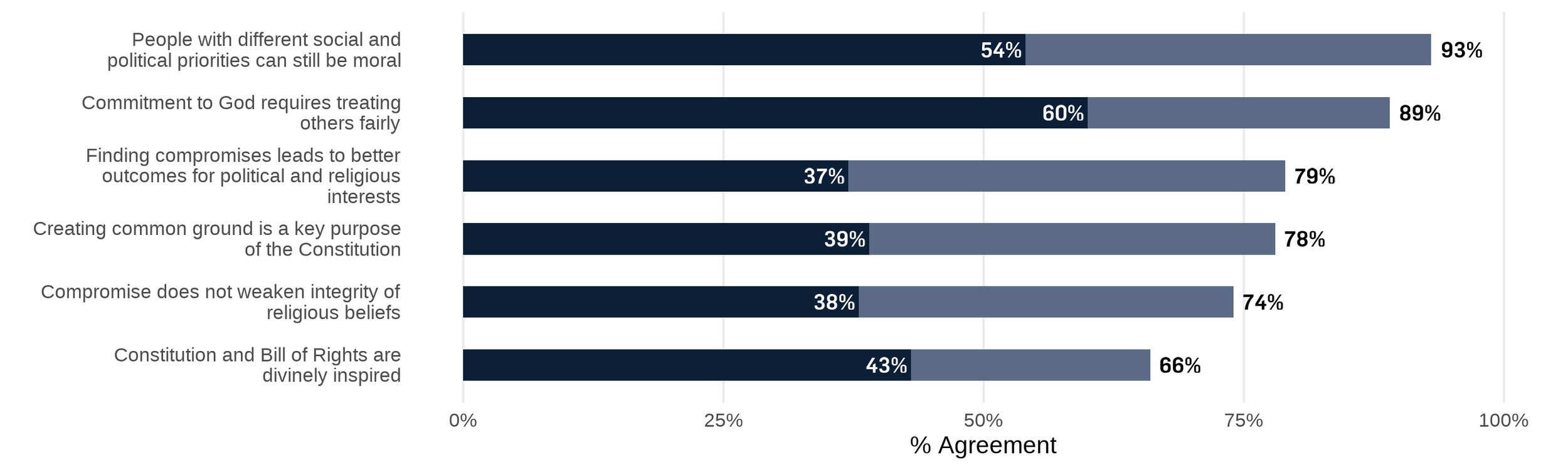
Nearly nine in ten Utahns (89%) agree that “a person’s commitment to God requires them to treat other people fairly,” and six in ten (60%) agree completely, the highest level of complete agreement for any statement. Even more Utahns (93%) agree that “a person may have different social and political priorities than me and still be considered moral.”
Among the four statements about faith and pluralism, the one with the least agreement with President Oaks was “Compromise usually weakens the integrity of religious beliefs.” President Oaks argued the opposite: that people can hold fast to their religious beliefs and values while still making room to compromise with others. Even so, 74% of Utahns sided with him by disagreeing with the statement, including 38% who disagreed completely. Across all six statements, the lowest agreement (66%) was for the statement that the Constitution and Bill of Rights are divinely inspired.
President Oaks’ positions drew agreement from Utahns of all backgrounds, though the intensity of that agreement varied by religion. Active members of The Church of Jesus Christ of Latter-day Saints were more likely than Utahns with no religious affiliation to agree completely that “a person’s commitment to God requires them to treat other people fairly” (71% vs. 49%). On the other hand, nonreligious Utahns were more likely than active Latter-day Saints to side with President Oaks by completely disagreeing that “compromise usually weakens the integrity of religious beliefs” (57% vs. 25%). Members of other faiths were the most likely to agree with that statement (37%), similar to active Latter-day Saints (33%).
Views differed most on whether the Constitution and Bill of Rights are divinely inspired. Active Latter-day Saints were the most likely to agree completely (69%), significantly more than members of other faiths (35%) and Utahns with no religious affiliation (14%). Less active Latter-day Saints (46%) were also significantly more likely than nonreligious Utahns to agree completely. Counting everyone who agreed completely or mostly, agreement reaches 89% among active Latter-day Saints, 81% among less active Latter-day Saints, and 64% among members of other faiths. Only Utahns with no religious affiliation were more likely to disagree than agree (32% agree).
Belief in a divinely inspired Constitution does not come at the expense of pluralism. About three in four active Latter-day Saints (76%) also agree that creating common ground is a key purpose of the Constitution, statistically the same as Utahns with no religious affiliation (78%). And nearly all active Latter-day Saints (96%) agree that a person with different social and political priorities can still be moral.
MORE THAN FOUR IN TEN UTAHNS HEARD ABOUT THE SPEECH; OF THOSE A LARGE MAJOIRTY VIEWED IT FAVORABLY
More than four in ten Utahns (44%) had seen, read, or heard something about the speech, though about half of that group (23% of all Utahns) had heard only a little. Active Latter-day Saints were by far the most likely to have heard about it (78%). These numbers will only increase as the speech continues to be read and discussed.
Among Utahns who had heard about the speech, reactions were overwhelmingly positive: 86% viewed it favorably, including 66% who viewed it very favorably. Active Latter-day Saints were the most enthusiastic, with 83% viewing it very favorably; no other religious group had a majority say the same. Utahns with no religious affiliation were more likely than active Latter-day Saints to describe their view as somewhat favorable (53% vs. 10%) or somewhat unfavorable (24% vs. 0%), and members of other faiths were also more likely to feel somewhat unfavorable (28% vs. 0%). Still, majorities of every religious group, including the nonreligious (63%), viewed the speech favorably. Because relatively few members of other faiths and nonreligious Utahns had heard about the speech, these subgroup estimates are less precise.
Reactions also had a political dimension. Very conservative Utahns received the speech most enthusiastically: 87% viewed it very favorably, significantly more than moderates and very liberal Utahns. Somewhat conservative Utahns were close behind (78%). When very and somewhat favorable views are combined, moderates top the list at 94% holding favorable views of the speech, compared with 89% of very conservative Utahns. The speech also found a moderately favorable audience on the left: 75% of somewhat liberal and 58% of very liberal Utahns who heard about it viewed it favorably, though about one in five very liberal respondents viewed it very unfavorably.
ABOUT THIS SURVEY
Y2 Analytics and Public Wisdom surveyed 547 Utah adults online from September 17 to 21, 2026. Respondents were drawn from a previously recruited opinion panel. Initial recruitment to the panel from the voter file was done using probability proportionate to size (PPS) sampling based on the voter’s modeled likelihood of turning out to vote in the 2026 general election. Survey invitations were sent via email and text message. Emails were self-administered online. Survey panelists were initially recruited by mail through the postal service or through a text message invitation and their contact information was provided when they agreed to join the panel after this initial contact. Panel members had to affirm when they were recruited that they are registered to vote in Utah.
The data have been weighted to reflect the demographics of likely 2026 general election voters living in Utah. The data were weighted by county of residence, congressional district, sex, age, party registration, recalled 2024 presidential vote, race, education level, and modeled turnout quintile.
The margin of error for the full sample is ±4.2 percentage points, or approximately ±5.7 points after accounting for the effect of weighting; margins of error are larger for subgroups. Active and less active Latter-day Saints were identified by a two step process during the initial recruitment survey. Respondents were initially asked their religious preference. Those that indicated some religious preference were then asked how active they consider themselves in the practice of their religious preference. Those who described themselves as “very active” are categorized as active Latter-day Saints.
Differences described as significant are statistically significant at p < .05 after correction for multiple comparisons. The full topline and crosstabs are available for download by clicking their respective links.
About Y2 Analytics
Y2 Analytics is a survey research and analytics firm based in Salt Lake City with extensive experience measuring and analyzing public opinion, predicting consumer behavior, and providing data-driven strategic consulting. For more information about the survey, contact Quin Monson at quin@y2analytics.com or (801) 367-6588. You can also contact Jade Burt at jade@y2analytics.com or (435) 799-1456. For more information about Y2 Analytics see https://y2analytics.com/.
ABOUT PUBLIC WISDOM
Public Wisdom is a survey research firm based in Denver that specializes in recruiting and fielding scientifically accurate survey panels through random probability sampling. For more information see https://publicwisdom.io/.